


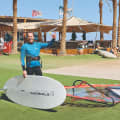
The Kleine Meer in East Frisia has always been something of an idyll. Covering just 93 hectares and situated right next to the Großes Meer – one of Lower Saxony’s hotspots for water sports enthusiasts – it was also Hieve This lake is said to offer a relaxed alternative to windsurfing and foiling. Professional windsurfer and foiler Klaas Voget took his first steps here in the shallow water, surrounded by reed beds. However, for several years now, the locals have been noticing a change in the lake that is making water sports increasingly difficult. We spoke to Detlef Hillers, who, as a sailor and local resident, knows the situation inside out.
Detlef, the Kleine Meer is your home spot, but it’s changing. What’s happening on the inland waterway?
The problem currently affects the Kleine Meer, known as Hieve, in particular. This is a popular inland spot amongst water sports enthusiasts in the immediate vicinity of the Great Sea. The Hieve is quite shallow, but has a dredging pit in the middle, where sand used to be extracted. The water in the Kleines Meer has actually always been brackish and brownish in colour. In 2018, a very hot summer, the water became increasingly clear; whilst surfing and sailing, we could suddenly see the seabed.


The problem is that, because the water is so clear, more sunlight is now getting through, allowing the algae to multiply rapidly. As a result, the lake becomes almost completely overgrown in summer. Only in the area around the dredging pit, where it is deep, was it still possible to go windsurfing and foil last summer, but space is, of course, very limited there.
Do you know anything about the scientific background? What brought about these changes?
It seems that, partly due to the higher temperatures, an invasive species – the freshwater mussel – has spread. It requires a specific water depth and has settled right at the edge of the dredging pit. The mussels have the ability to filter the water, which has made it clearer. This, in turn, has encouraged plant growth. With standard fins and foils, it’s now almost impossible to get through here in the summer.

The Great Sea is just a few hundred metres away; for water sports enthusiasts, this stretch of water is even more important – there’s even a surfing school there. Is the change happening there too?
Surprisingly, this hasn’t been the case to any great extent so far. This may also have something to do with the water depth, as the freshwater mussel requires certain conditions, which it seems to find at the Kleines Meer, right on the edge of the dredging pit. But there is, of course, a concern that things might develop in this direction here too.
Are there any other issues as well?
The algae are also increasingly crowding out the common reed, as the dead algae smother the young reed shoots at the edges. Browsing by geese and nutria – another invasive species – is also contributing to the decline of the common reed.
Is there a solution?
We are in close contact with the authorities. The ‘Kleines Meer’ is a landscape conservation area, so the stated aim is to preserve the existing cultural landscape. The owners and managers (the district and the state), who have drawn up a number of rules for water sports enthusiasts and local residents, are obliged to comply with the landscape conservation requirements. This includes maintenance measures to prevent overgrowth and the die-off of common reed. Naturally, water samples have also been taken here. The results showed that biodiversity and oxygen levels in the water are actually good and have even improved in recent years. These findings must be accepted, even if older sailors claim that the lake used to have a much higher salinity due to the influence of the tides. As such, there is currently no reason for the authorities to take any action, such as removing vegetation in certain areas. Nevertheless, we are naturally concerned that the water body is changing so drastically that water sports will no longer be possible here, and that water sports clubs will have to spend a great deal of money on authorised mowing operations to rid the ‘Kleines Meer’ of aquatic plants. Whether they will be able to cope with this is questionable.
Detlef, thank you for the interview.
Manuel Vogel
Editor surf