


From Anton Munz
What is wingskating?
Wingskating - what is it anyway? Until now, only the term "windskating", i.e. windsurfing on land, was generally known. Using a wing as an alternative means of propulsion is an obvious choice. All you need is a wing and a rolling base - a skateboard or even inline skates - and you're ready to go even in the weakest breeze. Not only is the whole thing incredibly fun and makes the slightest breeze interesting, it is also the easiest way to learn how to wingskate on the water. Wingskating paves the way for wingsurfing and foiling, because the wing control on land and on the water are almost identical. You ride stable on a skateboard without waves, so the less you have to concentrate on the board at the beginning, the faster and more efficiently you will learn how to handle your wing. In addition, a Skateboard The skateboard - especially a surf skateboard - is steered in a similar way to a foil board.
Wingskating is therefore a fascination for everyone - whether for novices who want to immerse themselves in wind sports or for water sports professionals who want to get to know new facets of their sport. In the following, I'll tell you what it's all about:
The right wingskate spot
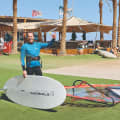
The pictures for this article were taken in a place that fulfils pretty much all the parameters of a perfect spot for wind and wingskating - the MFG5 area in Kiel: fine asphalt surfaces surrounded by gentle meadows extend into the well-ventilated Kiel Fjord. Constant wind and a perfectly flat surface - what more could you want? You can wingskate even in the lightest breeze, but the fun also works in stronger winds: minimal rolling resistance paired with a wing that can be effortlessly powered up or neutralised guarantee fun from five to over 15 knots of wind. Moderate winds of up to ten knots are ideal at the start. Find a car park, an open road or - with the right board - a well-ventilated dirt track for the start and off you go.


Which wing size?
It's best to use a small to medium-sized wing with 4-5 square metres to get the perfect balance between propulsion, manoeuvrability and ground clearance. At just over 180 centimetres tall and weighing 80 kg, I use a 5 m² wing. As I like to have a bit more "oomph" in the Wing and use it for jumps and off-road riding, a 5sqm is perfect for me. Of course, a larger wing has more wingspan than a smaller wing, which reduces the ground clearance: on a skateboard, you are practically standing on the ground and don't have half a metre of ground or "water clearance" underneath you, as is the case with wingfoiling. Smaller people should therefore choose a smaller wing of around 4 square metres. Otherwise they would have to constantly stretch the wing far upwards so that the wing tip does not kiss the tarmac. When wingskating with fast longboard wheels, you don't need as much pressure in the wing to get really fast anyway. This means that taller people can also use a small, handy wing.

Do you still have questions about how to set up the wing? Then you will find HERE a basic tutorial.
Which board for wingskating?
There are essentially four different types of board: classic Skateboards cruiserboards (in my case a Surfskate ), Longboards and Mountainboards . If you choose a skateboard with small wheels, the surface must be correspondingly smooth - without grooves or similar. A cruiser or longboard with larger wheels is best to start with because it "absorbs" bumps better. Personally, I now like to use a so-called mountainboard. This is an oversized skateboard with large pneumatic tyres. And just like a mountain bike, I can also ride it on uneven terrain such as meadows.

Straps give me extra grip and control on my mountain board, so I can even jump properly with them. You can find a clip of a nice session here:
Incidentally, I recently handed my Wing to a friend who was out and about on inline skates: after a few minutes of familiarisation, she whizzed past me with a huge grin on her face. Apparently, a Wing can also be perfectly combined with inline skates. With skates too, by the way! I'll be trying out this option next time, because it's always so much fun to learn new things with the Wing.
Wingskating safety
Although the wing tips are usually protected from abrasion by reinforcements, you should not overdo it with ground contact. To prevent the wing from "kissing the tarmac", you can either lift the wing quickly with your front hand or push the strut towards the ground with your back hand if contact with the ground is imminent - this causes the front tube and thus the wing to rise again. However, if the wing "bites" into the ground, you should quickly release the back hand and lift the front tube: The wing folds over and then floats freely in an inverted position. To return to the riding position, simply turn the wing on the front tube back to the correct side.

Finally, I generally recommend wearing protective clothing when wingskating due to the hard surface. I personally never ride without a helmet. Beginners in particular should also wear protectors in the form of Knee, elbow and wrist protectors wear.
Wingskating - Starting & braking
To get into the riding position, I first pull the wing over me. At first, I only grab the first loop with my front hand, let the wing float and then take my back hand on one of the back loops. This allows you to work your way carefully from front to back, with the front arm guiding the wing and ALWAYS keeping a firm grip on it. Furthermore, the front arm should always be stretched away from you and tending upwards. If the wing swings up or pulls too strongly, you can simply release the back hand and let the wing swing out above you again.

Generally speaking, the rear arm is your control stick. You can use it to move the centre stick forwards/backwards or downwards/upwards to control the direction of flight and the wing pressure. The centre tail also indicates where the wing is flying with the wing tip first. If you imagine a clock, the front tip of the wing or the centre tail points either to the "10 o'clock position" or to the "2 o'clock position", depending on the direction of travel.My tip:If you have no experience with the wing, take some time before your first launch, find a spot with wind and soft ground (sand, grass) and practise handling the wing on land.
To get started with wingskating, you should have ridden a skateboard before. First of all, position the board at right angles to the wind, push a little and ride back and forth with one hand on the front of the wing without any pressure from the wind: the wing floats behind you in a neutral position so that you can concentrate fully on steering the board. After a few laps, you can now bring the wing into the riding position to ride back and forth on a half-wind course, i.e. across the wind. Initially, you should only ride at walking pace to carefully get used to the riding behaviour. Take turns with your back hand to close up loosely and then fishtail again. However, if it gets too fast, you can let go of your back hand at any time and let the skateboard roll out - or jump off. Alternatively, you can steer the wing all the way up and, if necessary, ride into the wind to slow down with the headwind. As a general rule, if you only hold the wing by the front handle and release your back hand from the centre strut, the wing will hover in a neutral position - in this case it will not produce any propulsion, which will bring you to a standstill sooner or later.

In the next episode, I'll tell you all the tricks for advanced wingskaters - from jibing to switch-stance riding and jumping. Until then, have fun practising!
Your Anton
Manuel Vogel
Editor surf