SURF: Hellmut, longboards are currently experiencing a small renaissance. You have now revitalised the displacement class Division 2. Explain to anyone under 40 what it's all about and what drives you.
Division 2 was and is a construction class, which means that certain key data such as length, width and weight of the boards are specified. At the time, manufacturers were allowed to move freely within these specifications, which is why there are boards in the Division 2 class from many manufacturers. These include the Lechner Olympic board from 1988, the Mistral M1, Tornado, Alpha and many more. The key data was important to ensure a certain equality of opportunity in regattas. In the mid-80s, the funboard wave swept through the windsurfing world and swept away everything that wasn't short enough. People were suddenly building funboards in their own basements - including me - Hawaii was everywhere. Things started to crumble at the base. Looking back, it really hurt Division 2.

What can the displacers with their round keel do so well that they should be revived today?
First and foremost, the speed that you can achieve with it in light winds is fascinating, that's a difference even compared to normal longboards, funboards don't stand a chance anyway. I don't know of any board class that would be competitive in upwind conditions.
Displacers are considered demanding to surf...

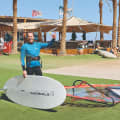
That's true, and that's exactly what makes them so appealing. The boards require some technique, they are long and, due to the keel, rather tippy and also challenging to jibe. You have to get to grips with them a little, but that's exactly what makes them so fascinating. There is also the attraction of having to be tactically sound when regatta surfing. I was a kiter for a long time so that I could get out on the water even when there was less wind - until I rediscovered displacement kites. Many inland waters have little wind and are therefore unsuitable for fun boards. Whenever I set up on the beach with my equipment, people come up to me and ask: "Where did you get the equipment? How do you get it? Is it still being built?"

Most windsurfers are likely to have disposed of such boards at some point. How do you get the right material today? Displacers are not currently being built.
Many people threw it away back then, but there are still many treasures lying dormant in garages and cellars across the country. I myself looked for something on Ebay and restored it. I also had an old sail cut with modern materials.

Not everyone has the opportunity to restore old boards. What other options are there?
There is now a real community in which material is also traded. You can find it on Facebook under Open Division 2 Germany, for example. Boards that are sold are around 150 to 500 euros, so you can get back into the game at a favourable price. But you can also buy new equipment! Onehundretboards from the Czech Republic builds custom boards that meet the specifications of Division 2. These are new constructions with state-of-the-art materials - hollow, reinforced with frames and elaborately handcrafted. Because you need moulds for the original fins and daggerboards, a lot of work is involved, the price is between 1600 and 2000 euros, the weight is 18 kilos or slightly less.

Couldn't the boards be built much more easily today?
Of course, this is also possible on request, 13 to 14 kilos are realistic. However, if you want to take part in regattas, you will have to take additional weights with you to ensure equal opportunities. Nowadays you can have sails made by sailmakers such as Doyle Raudaschl, in state-of-the-art materials if you wish. I myself had a triangular sail built with carbon fibre, a material used by racing yachts. In general, the triangular sails with their long booms and short battens produce good propulsion even in light winds. But if you want to get started, you can of course also use your normal, modern windsurf sail.
Keyword "regattas": What's going on and how many people are taking part?
We had a good starting field at the European Championships on the Ijsselmeer and the regatta tour is growing. More than ten events are scheduled throughout Europe in 2019 and we are working with local surf clubs to secure additional locations. There will be the Chiemsee Marathon on Lake Chiemsee in September and the Hessencup in August.
What does your regatta format look like?
We surf the classic triangular course, there is no pumping and we can start in virtually any wind up to 20 knots. This is also what appeals to many people: there is no risk of cancellation. Anyone who signs up will be able to surf the regatta, regardless of whether the wind is one knot or force five. In addition, there is of course a nostalgic component. You meet people you lost touch with many years ago and the old spirit is revived.
If you want to become part of the Division II community, you should download the corresponding Check Facebook group .
Manuel Vogel
Editor surf