


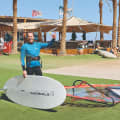
"The eternal runner-up" - admittedly a somewhat provocative headline for an interview in the April 2009 issue of surf magazine. But it actually expresses a great achievement. For many years, the only person ahead of Helge was Bernd Flessner, a full professional with extensive World Cup experience and a home in Norderney, who dominated the national windsurfing cup like Mercedes currently dominates Formula 1. Helge, on the other hand, lives in Hanover, has worked as a chimney sweep throughout his windsurfing career and has been running his own business as a master chimney sweep for six years. "Windsurfing has always been a well-paid hobby for me," he says looking back. After 25 years of racing, Helge has now retired from the German Windsurfing Cup.
25 years is a long time. Can you still remember your first regatta? Quite accurately, in fact. At the time, Ingo Meyer was the big hero in Hanover. He raced in the World Cup and I always bought his old sails from him. At some point, he asked me if I wanted to come along to St Peter-Ording for a GWSA regatta. I had just had my driving licence for a week and my parents were on holiday. I just grabbed my mum's VW Polo without asking and then we took the motorway north with three people packed in. That was pretty reckless and caused a lot of trouble afterwards. Of course we also got stuck on the beach in St Peter, but in the evening there was a big party as usual and everyone went wild. I didn't know that from Hanover and I realised that this was my thing. So in the beginning it was mainly the lifestyle that fascinated me.

After that I borrowed some equipment and went to a regatta in Klitmøller. There I realised that I wasn't that fast yet, but I was always overtaking at the gybes. A lot of other surfers fell in at the buoy and I thought to myself that with a bit of training you could be at the front. In Hanover, I went to a surf shop called "Fresh Breeze" and asked about sponsorship.

Just like that - was it that easy back then? Yes, those were different times. In the shop, they told me that someone in Munich was setting up a team for the NPU sailing brand. I should give him a call. It was Axel Reese and he told me that he would soon be at the World Cup on Sylt and that I should come round. So that's what I did. I came to the beach where Axel was rigging and spoke to him. He just looked at me briefly and said: 'Ok, we'll do that! Somehow, with my bleached blonde hair and my motivation, I fitted in perfectly with the concept. I then got boards from Mistral and had four racing sails, two boards and wave gear for the first season. That was really good. Incidentally, I came 36th in my first season. Back then, the regatta fields were still really full, with 80 or more people often starting.
How has the atmosphere at the regattas changed since then? It's become a bit stuffy. We didn't take it all so seriously back then. The lifestyle often took centre stage. The wind forecasts weren't that accurate and so it could happen that we partied all night and suddenly there was wind the next morning. The top riders were also there. Ingo Meyer, Andreas Stielert, Jürgen Dach and especially Andy Laufer didn't miss a beat. This sometimes led to very funny scenes when nobody really knew how many laps the course had. Of course, we were all ambitious and sometimes argued loudly on the course and on the beach. I even shouted at my best racing mate Thade Berends on the beach. But afterwards we all celebrated together again. Hardly anyone went to the regattas with their parents. That's different today. The young racers often have their fathers with them, are well equipped and have a lot of pressure. That's more professional, of course.

Was the level higher in the past? I wouldn't say that. However, you also need a lot of experience to be able to ride at the front. It also took me a few years before I was consistently in the top ten. Bernd was always at the front, who, after not racing regularly in the World Cup, concentrated on the national regattas as a full professional. When everything went right for him, he was actually unbeatable. Of course, it was even better when I could beat him. I always had a very good relationship with Bernd, but he really couldn't lose well. It was difficult for him to congratulate me. It hardly ever happened that he went up to you and said, "Ej, great driving" or something like that.
Did it annoy you that you never really got past Bernd? Of course it wasn't easy. But Bernd was always a professional. I could have tried to concentrate fully on windsurfing. I was lucky enough to have a great boss who was a sailor himself and gave me a lot of freedom. I also took a month's unpaid holiday and went to the south of France for training in the spring to see if I could compete in the international regattas there. I was about 30 years old at the time and thought to myself, maybe you should try to become a real professional windsurfer after all. But I realised that the level and the effort involved were so high that I didn't trust myself to compete at the front. In hindsight, I think I did everything right. I've always worked during my career, built up a company and a family with two children. If I stop now, I don't have to worry about my future. And I now have the freedom to go surfing when there's wind. During my active time, I always had such good sponsorship contracts that I made a small profit at the end of the season.
Is it still possible to make a living as a regatta driver from the bonuses and sponsorship? It depends on what you need to live on. Whether you can survive on 10,000 euros a year or need 100,000. It also depends a lot on how you market yourself and what your goals are. Vincent Langer does this very consistently. He hardly rides any World Cups, but concentrates on the national series and the big IFCA championships and markets that very consistently. Bernd did the same and it worked well. It's simply clever to say that I'll ride where I can be at the front and not take the knock in the World Cup. Basti Kördel goes the other way. He has a big private sponsor who enables him to race in all the slalom World Cups. And he has the ambition to get to the top. It's a long and hard road, because the racers in the World Cup are extremely strong and the risk of not making it to the top is very high. But I think it's good that a German is trying again. But in the World Cup you need years to be at the top. A 15th place in the World Cup is very respectable in sporting terms, but it's not so easy to market.


How do you see the situation for young talent in Germany - is there talent growing up that can also make it internationally? There are already some very good young riders. You really have to pat Vincent Langer on the back. He seems to be a gifted teacher. He brings on really good people with his camps in Kiel. A large proportion of the riders who are now pushing into the top ten come from his circle. I think it's really impressive what he's doing, especially because he's breeding his own competition. Nico Prien is the best example of this, he's already given Vincent and Gunnar Asmussen a run for their money. And the boys now also go to Tenerife or other spots in winter for slalom training and train properly with buoys, launch boats and lots of other good riders. We would never have done that in the past. When the season was over, we only had the waveboard in our luggage. Most of the riders were also really good in the waves - Laufer, Ingo Meyer and Flessi. If there are good wave conditions somewhere and offshore wind for slalom training next door, I would never think of using a slalom board. Windsurfing in the waves is simply the greatest thing for me, even though I don't come from the coast and that's my best discipline. Nowadays, a lot of people are already very specialised in slalom and racing, I think they drown when they're on a wave board (laughs). There are only a few really good all-rounders. I think Nico Prien is right up there. I think he has what it takes. He's also really good in the waves.
Is the specialisation also due to the championship mode? The slalom riders and racers clearly dominate the top ten in the overall standings. That's true. I think an overall ranking is great. But at the moment, two disciplines out of four count and you can include your slalom and race results. I think it would be much better if you had to include a technical discipline, i.e. freestyle or wave, and a racing discipline, i.e. formula windsurfing or slalom. I don't think it's acceptable for someone to be very high up in the overall rankings if they don't even compete in the waves. The best all-round windsurfers who are good in different disciplines should appear there.
Slalom and formula racing have become quite material battles. Doesn't that put young drivers off when they see how much stuff is needed to keep up with the front runners? I've actually always been in favour of material restrictions. That doesn't just apply to boards and sails, but especially to fins. When the guys suddenly arrived with fins from Kasey costing 1800 dollars, I briefly thought about whether I would call it a day. The bad thing was that they were actually a touch faster, so you had to go along with the madness. I don't want to know what values Vincent Langer is travelling around in his fin bags.
They're probably more expensive than the car he drives them around in? Could be. I would have liked to see some regulation. However, for a while we had a material restriction in the hope that more newcomers would come to racing, but that didn't work either. I think it would be good if, for example, you had to register two slalom boards at the start of the season and then compete in all regattas with them. I think that would be an even higher sporting achievement if you have to cope with two boards in all conditions.
Wouldn't it make sense for Choppy Water, as the agency responsible for the German Windsurf Cup, to take stronger action? I don't really want to put too much blame on Choppy. They're already doing a good job and are getting the riders more involved. Anyone can complain. I don't think anyone could do it better at the moment. But of course there is a strong Kiel influence in the DWC and that often prevails in the votes.

Looking back on your 25 years in racing, what was your greatest success? Certainly when I became German Formula Racing Champion in 2001. All the good people were at the start and it was very close right to the end. I would never have thought that I would become German champion. I mean, it's really cool to become German champion anyway, regardless of the discipline. That was never my goal when I started. I'm sure other people set themselves much higher goals. I always thought that if I finished in midfield, that would be enough for me. In that respect, it was something very special.
And what was the biggest disappointment? (ponders) I couldn't really say anything. But when Thade Behrends stopped racing, I was disappointed. We were great friends on the tour for 20 years. But we often shouted at each other at the buoy on the course. Once we almost shook each other on the beach, I pushed him away and we shouted at each other. We lived together and slept in the same bed (laughs). Everything was fine afterwards. It was a shame when he was no longer there, but we're still in contact now.
You've been to a regatta somewhere almost every weekend in the summer for many years now. Did your wife always put up with it without complaint? Less and less in recent years. It was very often the same places. I don't know how often we travelled to Sylt. Apart from the regattas, there was hardly any time for normal holidays, we could only rarely go to places she liked. It's just not possible to fly to New York for a fortnight after a week on Sylt if you also have a normal job. But we'll make up for that now. We're flying to New York and I probably won't be taking a windsurfer with me. Or maybe I will, I'll have to ask a friend who lives in the Hamptons whether it might be worth taking equipment with us.
When did you decide to end your career? It was more of a gradual process. As long as you can ride at the front, you don't stop. But of course I noticed that the youngsters were getting better and better, also because they can train a lot more and are also very ambitious. So my motivation slowly went down more and more. And a decisive moment, as I've already mentioned several times, was when I packed all my clothes into the car for the first Cup on Sylt last year. It was cold, the forecast was bad and I didn't feel like travelling to the island for the umpteenth time. I got really depressed.

And from now on you're only going on cultural and city trips? Of course not. I've also got slalom boards from Starboard for this year and I'll be taking part in a few more small regattas. I'm also helping to organise the regattas here at Steinhuder Meer and I'll definitely be surfing in the "Wolle Ricke Cup" and the "Dümmer Open" if the conditions are good. Apart from that, I now have the freedom to surf for a few hours at Steinhuder Meer when there's wind in the morning and only then go to the office. There are also a lot of beautiful places where I still want to go windsurfing.
Is there a situation in your career that you will never forget? Yes, that was back in the days when Ingo Meyer and Didi Kornelli were travelling with us. We were on Sylt and had once again only come out of American's (the ed.: bar in Westerland) in daylight. We were staying in a house with ten people and suddenly we realised that there was wind. Everyone rushed to the beach and I tore the sleeve off my wetsuit when I jumped over a hedge. Regatta organiser Walter Mielke had scheduled a slalom with several laps in an offshore wind. But nobody knew exactly how many. Some only did two laps, others three or even four. It was a complete mess and there was a lot of shouting on the beach. Everyone insisted that they had done everything right. It wasn't funny at the time, but later we all had a good laugh about it.

Manuel Vogel
Editor surf