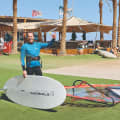
Test 2020Pulse Boards Intro 100

Manuel Vogel

 · 09.01.2020

Test 2020: Pulse Boards Intro 100Photo: Marius Gugg
Test 2020: Pulse Boards Intro 100
The custom forge Puls Boards was founded by Polish shaper Stefan Leciejewski and currently offers five board lines from the wave and freestyle segments - we were able to test ride the Intro 100 model.

On land:

The Puls Intro 100 is designed as a freewave board. The shape itself is "off the peg", all other parameters such as construction, stance and strap width, design or fin setup can be customised. Depending on the version, the Intro costs between 1270 and 1800 euros; we were out on the Baltic Sea with the basic version - called the Silver Edition. When ordering, 50 per cent of the purchase price is due immediately. The delivery time is six to twelve weeks and Puls offers a warranty of up to two years, depending on the design.

On the water:

The shape and finish look absolutely impeccable from the outside, and at 7.04 kilos, the heaviest of the three Puls designs is within the usual range, despite its low price. The shape appears to be more wave orientated, which is immediately noticeable. The Intro planes quite effortlessly, but its rather cosy acceleration doesn't really get the pilot's pulse racing. In strong winds and chop, we were absolutely convinced by the control and smoothness, but at the lower wind limit a little more liveliness would be an advantage. The Intro prefers to turn tightly around corners and runs smoothly and softly on the edge - tight jibes against the swell or fast hooks in small surf suit the shape exceptionally well. On the other hand, long carved, glided radii are not the absolute domain of the shape.

Prefers tight turns to wide radii - the Puls IntroPhoto: Marius GuggPrefers tight turns to wide radii - the Puls Intro

surf conclusion:

In any case, the Puls Intro is an attractive alternative for all those who expect tight turning and good control from a 100-litre board. The price and customisation options are also good arguments in favour of the board. For fast bump & jump or as a flat water board for heating with sail sizes beyond 5.5 square metres, it lacks some speed potential.

How do you like this article?

Info under: www.pulsboards.com

You can read this article or the entire issue of SURF 1-2/2020 in the SURF app (<a href="https://itunes.apple.com/de/app/surf/id761387049?mt=8" rel="noopener noreferrer">iTunes</a> and <a href="https://play.google.com/store/apps/details?id=de.deliusklasing.surf" rel="noopener noreferrer">Google Play</a> ) - the print edition is available <a href="https://www.delius-klasing.de/surf-01-02-2020-sur-2020-02" target="_blank" rel="noopener noreferrer nofollow">here</a> .Photo: Jerome HouyvetYou can read this article or the entire issue of SURF 1-2/2020 in the SURF app (iTunes and Google Play ) - the print edition is available here .
Manuel Vogel

Manuel Vogel

Editor surf

Manuel Vogel, born in 1981, lives in Kiel and learned to windsurf at the age of six at his father's surf school. In 1997, he completed his training as a windsurfing instructor and worked for over 15 years as a windsurfing instructor in various centers, at Kiel University sports and in the coaching team of the “Young Guns” freestyle camps. He has been part of the surf test team since 2003. After completing his teaching degree in 2013, he followed his heart and started as editor of surf magazine for the test and riding technique sections. Since 2021, he has also been active in wingfoiling - mainly at his home spots on the Baltic Sea or in the waves of Denmark.

Most read in category Windsurfing