


You still think sailing is a boring old man's sport? Then you've never watched a race in the SailGP. The worldwide racing series for foil cats is not only developing more and more into the Formula 1 of sailing in terms of image, but also in terms of speed on the water. The teams race at speeds of more than 90 km/h over a small course, often in spectator-friendly locations on the shores of large metropolises by the sea. Since last year, there has also been a Team Germany at the start, whose skipper is Olympic medallist Erik Heil and one of the team's owners is four-time Formula 1 world champion Sebastian Vettel. The 15-metre-long catamarans and the racing series founded by five-time America's Cup winner Russel Coutts currently represent the spearhead of sailing. In his spare time, however, Erik, who lives in Strande near Kiel, loves to hop from his monster catamaran onto a tiny wingfoil board. We met him at home shortly before the next race in Bermuda.

You sail in the SailGP, probably the most high-tech sailing class next to the America's Cup, with incredible technical refinements and possibilities. Isn't wingfoiling boring as hell in comparison?
First of all, it's just fun. I like steering with my feet. It's simple. You don't have a lot of stuff to manoeuvre around. It's even less than windsurfing. The dimensions are a bit more compact. You can start quite early. It's fun very quickly. With surfing, it was always the case that you only really got going when there was a lot of wind. The same goes for kiting. The best range for wingfoiling is between 10 and 13 knots. It's a relaxed gliding feeling. Like some people drive out in their classic cars. I like to go wingfoiling.

What was your first contact with foiling in general?
It was probably the Motte and then the G32 - also a catamaran.
When did you start foiling while sailing?
I think the moth really took off at the end of the 90s. We were actually late in 2014, but still very early in Germany. We travelled a lot with the first Moth as a parallel programme to Olympic sailing.
What fascinated you about the foil and the moth?
The speed, that's cool. And we thought unstable boats were cool anyway, with the 49er (Olympic class, in which Erik won the bronze medal with his co-skipper Thomas Pößel in Rio 2016 and Tokyo 2021, editor's note. ) we were also close to it. It's relatively quiet, you have to say. It was also a bit frightening at times when we were training with the 49er and a moth came from behind and you couldn't hear a thing.
I'm fascinated by the speed, that's cool. And we thought unstable boats were cool anyway!"

You already had a very good reputation in the sailing scene thanks to your successes in the 49er and other classes. But how did you end up skippering for Team Germany in the SailGP?
Russel Coutts launched the league in 2019. As a five-time America's Cup winner, he is a legend in sailing. Three or four years ago, he asked if we in Germany would be interested in the league and wrote to me. I was quite surprised, because you don't really hear anything directly from someone like that. But he had apparently been following our sailing career and then wrote to us. We said: Yes, I'd love to. But we're still busy preparing for the Olympic Games in Tokyo, so we won't really have time to look for sponsors. We had an agency in Munich for that, but that didn't work out well and things fizzled out a bit.
At this point, you will find external content that complements the article. You can display and hide it with a click.
After a year, we gave Russel the feedback that we wanted to continue, but that nothing had happened. Russel then approached Thomas Riedel. He's a global player in the communications sector and a really cool guy. He does really innovative projects. For example, he delivered 80,000 walkie-talkies to the Olympic Games and does all the broadcasts of the America's Cup, the GP, Formula 1 and so on. His business actually started at the age of 13 as a magician, and he later lent his stage equipment to other artists. He also developed small pins for windsurfing boards, which are under the board to measure all the forces. He set up an office in Portugal specifically for this purpose, where a number of experts tried to draw new conclusions. This shows how meticulously he approaches new things.
Thomas was enthusiastic about the SailGP and tried to combine the enthusiasm and fun with a business concept. He checked out the media landscape and looked at what and who might be a good fit for the project? This is how the contact with Sebastian Vettel came about. As a four-time Formula 1 world champion, he was very interested in the highly technical SailGP. He also liked the sustainability concept of the series. Sebastian then became co-owner of the team and was able to contribute a lot of his experience to the project.

You know Sebastian Vettel from Formula 1, of course, but he hasn't had any connection to sailing so far, has he?
That's really interesting, because I also thought that if you have no connection to sailing, then there are no real parallels. But it's great because he asks you so many questions after just a few minutes that you can't really answer any more. The sailor is at the end of his tether relatively early on, but he's used to scrutinising things down to the last detail. But he's also a super relaxed and funny guy. We met here in the hall, he slept in his campervan in the hall and we had our first meeting here.
You have the comparison from very small to very large - what is the earliest way to foil?
The SailGP boats can almost always foil. We now have new T-Foils, up to now we have been travelling with L-Foils. The T-foils are becoming even more efficient. If we want to foil at 5 or 6 knots, we put on a kind of propeller that is only in the water when we are not foiling to speed up the boat. We are talking about areas like Dubai. We have three configurations of the wing. We basically sail from 5 knots to 30 knots. You can also foil early with the Moth, but I only have a medium foil. I would dare to use it here in offshore conditions from 10, 11 knots to 20 knots. And wing foiling tends to be between 13 and 25 knots.
No matter what you do, as long as you're on the water, it's a good workout!"
Do you feel that you can take something from a simple sport like wing-foiling that will help you later on the boat?
Yes, definitely. You realise when you're driving how and when it works efficiently. You get a feel for it. We haven't set up the team so professionally yet. We actually wanted to make a wingfoil package for each team member so that they could train at home. Playful training like that is always cool. I hated sitting in a gym. We were lucky in our youth in Berlin. We always had some kind of training - sailing, windsurfing or even wakeboarding. No matter what you do, as long as you're on the water, it's a good workout.

How do you see it? Isn't what we do technically with wingfoiling totally child's play compared to the sailors? Shouldn't we also be using an L-foil like you?
You can't really put it like that. So the T-Foils are more efficient. I am supported by Starboard and AK Wings. Up to now, I've always waited for the tube to merge harmoniously into the body of the sail so that there isn't so much dead space behind the tube. But Starboard is now doing that with the new wings.
Thank you Erik for the insights into the world of SailGP and good luck on the tour.
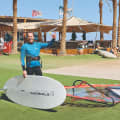
Manuel Vogel
Editor surf