Windsurfing basicsThe most important terms for windsurfing beginners

Manuel Vogel

 · 14.03.2023

The most important windsurfing terms for beginners: bow, tail, luff, leech, lower leech and...
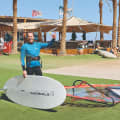
Photo: Oliver Maier
There's gibberish in every sport, and when windsurfers talk about their equipment, you often don't understand what they're saying. So here's a brief overview of the most important windsurfing terms.

In this article:

For beginners, the technical language of windsurfing may seem a little complicated at first. But this is deceptive, as you quickly get used to the most important terms during your first lesson in a surf course. These are important in order to understand the surf instructor's instructions straight away. "Tilt the boom towards the tail" or "Put your back foot between the straps!" are easy to understand if you memorise the most important windsurfing terms. And sooner than you think, you'll be using these expressions as a matter of course!


Boom (short: fork)

Used to hold the sail in place. Is fixed to the mast with the head piece; an adapter is required depending on the thickness of the mast.

Boom with front piece for attachment to the mastPhoto: Oliver MaierBoom with front piece for attachment to the mast

Boom pins

Used to adjust the boom length when using sails of different sizes.

Boom pins with which the length can be adjustedPhoto: Oliver MaierBoom pins with which the length can be adjusted

Mast

Fibreglass and/or carbon pole on which the sail is mounted; is pushed into the mast sleeve; can be divided at the plug-in connection.

Two-part mastPhoto: Oliver MaierTwo-part mast

extension

Adapter that compensates for the difference in length between the mast and the sail; the sail is tensioned lengthways on the downhaul rope.

How do you like this article?
Extension with threaded downhaul ropePhoto: Oliver MaierExtension with threaded downhaul rope

base plate

Rubber connection between board and sail, which is screwed into the board's mast track and inserted into the extension.

The base plate connects board and rigPhoto: Oliver MaierThe base plate connects board and rig

fin

Keeps the board on course; fastening in the fin box.

The fin sits in the tail on the lower sidePhoto: Oliver MaierThe fin sits in the tail on the lower side

Foot straps (straps for short)

Provide a secure hold for the feet on the board; screwed into the plugs and onto the footpads.

Foot straps, footpads and plugsPhoto: Oliver MaierFoot straps, footpads and plugs

outhaul rope

Rope with which the sail is tensioned transversely at the back end of the boom; the rear corner of the sail is called the "outhaul".

Outhaul rope on the outhaul, the aft corner of the sailPhoto: Oliver MaierOuthaul rope on the outhaul, the aft corner of the sail

Batten

Fibreglass or carbon rods that stabilise the profile of the sail; fixed with the batten tensioner.

Batten with tensionerPhoto: Oliver MaierBatten with tensioner

Sailing top

Cap in which the mast sits; length-adjustable vario stops can compensate for length differences between mast and luff.

Adjustable sail topPhoto: Oliver MaierAdjustable sail top


Also interesting:

Manuel Vogel

Manuel Vogel

Editor surf

Manuel Vogel, born in 1981, lives in Kiel and learned to windsurf at the age of six at his father's surf school. In 1997, he completed his training as a windsurfing instructor and worked for over 15 years as a windsurfing instructor in various centers, at Kiel University sports and in the coaching team of the “Young Guns” freestyle camps. He has been part of the surf test team since 2003. After completing his teaching degree in 2013, he followed his heart and started as editor of surf magazine for the test and riding technique sections. Since 2021, he has also been active in wingfoiling - mainly at his home spots on the Baltic Sea or in the waves of Denmark.

Most read in category Windsurfing